

A New Pathway for International Vets?

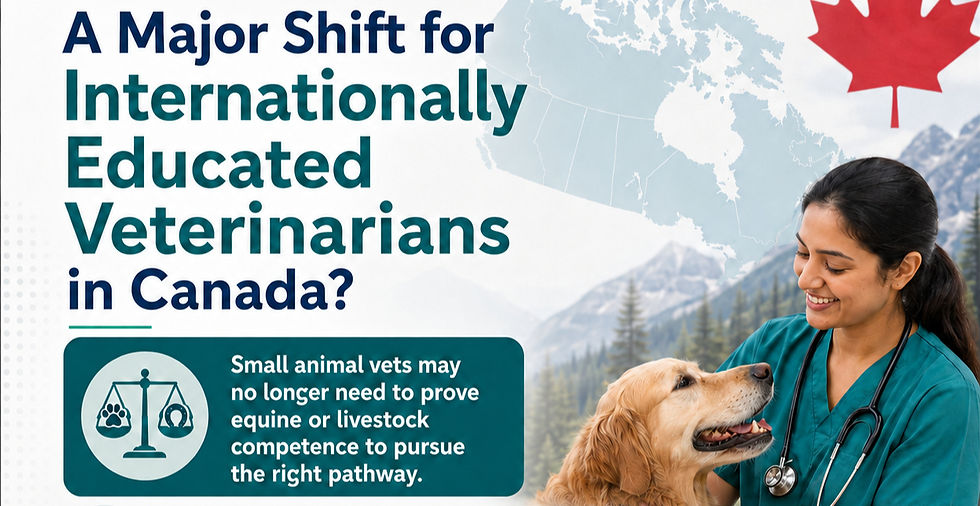
For many veterinarians trained outside Canada, one of the biggest challenges has been proving broad competency across multiple species — even when their actual experience is focused in one area.
For example: A veterinarian who has spent years working in small animal practice may want to work with dogs and cats in Canada — but traditional pathways often require broader assessment across species areas such as livestock or equine medicine.
That may be changing.
The CVMA recently shared that a Competence Assessment for Limited Practice pathway is under development for experienced internationally educated veterinarians in companion animal, production animal, and equine practice. This pathway focuses on demonstrated competence through portfolio assessment and supervised practice evaluation.
In Ontario, the College of Veterinarians of Ontario has also approved a new limited licensure pathway that will allow internationally educated veterinarians to access a licence limited to the areas where they demonstrate competence. CVO notes that traditional broad competency requirements have been a barrier for veterinarians with more focused education or work experience.
This could be an important step forward.
A small animal veterinarian may be assessed for small animal practice. A production animal veterinarian may be assessed for production animal practice. An equine veterinarian may be assessed for equine practice.
The goal is not to lower standards — it is to assess veterinarians more fairly based on their actual training, experience, and demonstrated competence.
For Canada, this could support:
better access to veterinary care
rural and underserved communities
shelter and community medicine
workforce sustainability
clearer pathways for experienced international veterinarians
Canada still needs more domestic veterinary training capacity. But at the same time, competency-based limited licensure may help experienced international veterinarians contribute sooner and more appropriately within their proven areas of practice.
This is a very important development for the future of veterinary medicine in Canada.



Comments